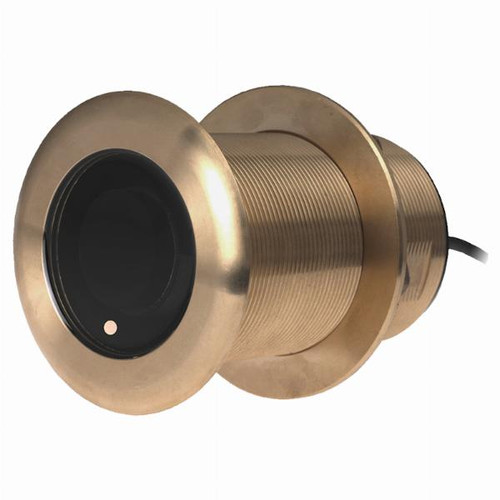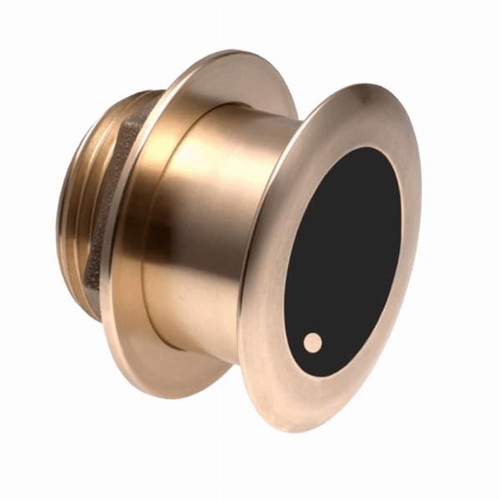



AIRMAR B60 50/200kHz 600W, 20 Degree Through Hull Transducer - Depth, Temperature
The B60 is a 600 W, 50/200 kHz transducer that integrates Airmar’s popular Tilted Element feature. This Tilted Element transducer has the ceramic element fixed at a 20° angle within the housing. When the transducer is installed almost flush to the hull, the tilt of the element corrects for the hull deadrise angle. By orienting the beam directly down, it ensures maximum echo returns to the transducer for more-accurate depth readings. The 20° tilted element is designed for 16 to 24° hull deadrise angles
Features
- Depth and fast-response water temperature sensing
- 600 W of power
- Dual-frequency element:
- 50 kHz with a wide 45° beamwidth for depth performance to 366 m (1200')
- 200 kHz with a 12° beamwidth for depth performance to 213 m (700')
- Perfect for center-console or trailered boats
- Low-profile bronze housing extends only 5 mm (3/16") outside the hull
- No effect on your boat’s running performance
- Bronze housing for fiberglass or wood hull
- Also available in a stainless steel housing (SS60) for use with all hull materials
Specifications
- Max Deadrise Angle: 24°
- Functions: Depth, Temperature
- Hull Material: Fiberglass or wood
- Max Vessel LOA: Up to 8 m (26')
- Hole Size: 60 mm (2-3/8")
- Usable Shaft Length: 68.5 mm (2.70")
- Display Connector: Cable Required
- Acoustic Window: Urethane
- Cable-Length: 2 m (7')
- Common Use: Leisure/Yachting, Fishing
- Connector: Airmar 5-Pin (MM)
- Conventional Beam: 45°/12°
- Country of Origin: USA
- Deadrise Range: 16° to 24°
- Frequency Band: 50/200 kHz
- Material: Bronze
- Max Depth: Low frequency- 366 m (1200'), High frequency- 213 m (700')
- Mix and Match Series: 5-Pin 600 Watt
- Mounting Style: Tilted Element Thru-Hull
- Power Rating: 600 W
- Retractable housing: No
- Sensor Connector: MM
- Single or Dual Frequency: Conventional Dual Frequency
- Tilt Angle: 20°
- Weight: 1.4 kg (3 lb.)
| Part Number | Bundled M&M Connector Included1 | Brand Part Number2 |
|---|---|---|
| AIR-B164-20-MM | None - AIRMAR Mix & Match Connector Only | Not Applicable |
| AIR-B60-20-10F | Furuno 10-pin | 525T-LTD/20 |
| AIR-B60-20-G6 | Garmin 6-pin | |
| AIR-B60-20-G8 | Garmin 8-pin | 010-10982-20 |
| AIR-B60-20-HB | HumminBird #9 | |
| AIR-B60-20-9N | Navico 9-pin | 000-16187-001 |
| AIR-B60-20-RAY | Raymarine 7-pin | E66087 |
1 Branded Mix & Match AIRMAR transducers come with a 1m cable to connect to the specific head unit (Garmin, Raymarine, etc) at one end, and to the universal M&M plug on the other end.
2 Provided as a guide only. Part numbers may not be current.
Frequently Asked Questions
-
What is a transducer and why does the material matter (plastic vs. bronze vs. stainless steel)?
A transducer sends and receives sonar signals for depth, speed, and fish-finding data. Airmar makes transducers in plastic, bronze, and stainless steel. Plastic is the most affordable and works well on all hulls, bronze offers excellent durability and is a common choice for saltwater boats, and stainless steel is prized for its strength and corrosion resistance on performance or metal-hulled boats
-
How do I choose the right transducer for my boat's hull type?
The main hull materials — fiberglass, aluminium, wood, and steel — each pair best with certain transducer types and mounting styles (transom-mount, through-hull, or in-hull). Fiberglass hulls are the most versatile and support all mounting options, while aluminium and steel hulls require specific through-hull fittings or housings to avoid corrosion issues (like galvanic corrosion between dissimilar metals). Additionally, in-hull transducers only work with solid fibreglass hulls.
-
What's the difference between transom-mount, through-hull, and in-hull transducers?
Transom-mount transducers attach to the outside of the transom and are the easiest to install (no hull penetration required). Through-hull transducers pass through a hole in the hull for the most direct water contact and best signal quality, especially at higher speeds. In-hull transducers are mounted inside the hull against the inner surface using epoxy, require no drilling, and can be installed whilst on the water.
-
What does the "coverage" or beam angle of a transducer mean, and how do I pick the right one for my boat's deadrise?
Beam angle affects how wide an area the transducer "sees" underwater, the Airmar bottom coverage calculator (linked above) can be used to calculate area of coverage at specific depths. Deadrise, or the angle of the hull to horizontal, must be considered to ensure the transducer faces straight down. Some transducers are offset or adjustable, so make sure your deadrise fits within the listed values of deadrise angle.
-
Can I use my existing transducer with a new fish finder or chartplotter?
It depends on compatibility between the transducer's connector type and the electronics' supported protocols (e.g., CHIRP, SideScan, NMEA 2000). These Airmar transducers use a universal "Mix & Match" cable system so they can pair with multiple major fish finder brands, but check the specific model's compatibility to be sure
-
What is Airmar's Mix & Match System?
Rather than buying a transducer permanently wired to one brand's connector, Airmar builds a generic base transducer with a universal Airmar plug, then lets you pair it with a separate adapter cable for whatever fishfinder or chartplotter brand you're using. These base models are identified by an “MM” suffix, such as B117-MM or B60-MM.
This means the same base transducer can work with dozens of different sonar units across many manufacturer categories — Simrad, Furuno, Garmin, Humminbird, Raymarine, and more — just by changing the adapter cable. If you switch fishfinder brands down the line, you only need to buy a new adapter cable rather than replace the transducer itself.
The physical connector depends on the transducer's power rating. 600W models (such as the B117, B45, B60, P319, P66, P79, SS505, and SS60) use a 5-pin connector system. 1kW models (such as the B164, B258, B260, M260, and TM260) use a 9-pin connector. CHIRP 1kW models (such as the TM185, TM265, TM275, and B275) use a 12-pin connector with a permanently attached cable. High-power 2–3kW models use a bare-wire cable connecting to a junction or adapter block instead.
One important note: cables are not interchangeable across power classes. A 600W Mix & Match cable cannot be used with a 1kW transducer, and a CHIRP Mix & Match cable cannot be used with a conventional 50/200kHz transducer. The cable must match both the transducer's power class and your electronics brand.
| Part Number | Bundled M&M Connector Included |
|---|---|
| AIR-B60-20-MM | None - AIRMAR Mix & Match Connector Only |
| AIR-B60-20-10F | Furuno 10-pin |
| AIR-B60-20-G6 | Garmin 6-pin |
| AIR-B60-20-G8 | Garmin 8-pin |
| AIR-B60-20-HB | HumminBird #9 |
| AIR-B60-20-9N | Navico 9-pin |
| AIR-B60-20-RAY | Raymarine 7-pin |